Some of the problems are well-known: the loneliness of being a minority group and strain from constant battles against basses. All unsuspecting, however, many tenors face the additional hazard of eternal damnation.
Of course, this is a problem that confronts every unrepentant sinner, but the tenor has special difficulties. Naturally, this is not because tenors are particularly sinful. No, the problem arises through the eleventh commandment, “Thou shalt not be found out”. Special measures have been taken to detect tenors in the commission of sin. An investigator has been at work for centuries: Titivillus.
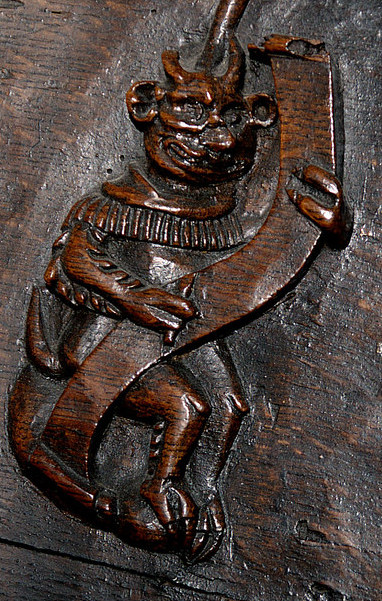
Titivillus (spellings vary – Tutivillus or Titivil are equally possible) is an imp, a minor demon, sent out to likely places to detect sin. Titivillus’ original instructions were to attend at Mass. Any words that the priest mumbled or skipped were pounced upon, and produced in evidence later, at the Day of Judgement.
Titivillus has also been reported as active in monasteries and later in printing shops – collecting the words that scribes and copyists got wrong, or that printers mis-set. Some people have even assumed that by now he must be looking over the shoulders of webmasters.
While he was hanging about in churches, the increasing activities of musicians came to his notice, and it was then that the fateful extension to his job description was made. Some singers started to sing notes differently from the others. As they sang higher, over the centuries, it became clear that it was not only their chests that were swelling, but also their heads. Titivillus began his new task—recording all the notes that tenors sing to their own glory, rather than the glory of God.
Medieval eyewitnesses — and whose evidence could be more trustworthy than Abbot Caesarius of Heisterbach? — tell us that Titivillus originally captured these errors in a “grete sacke in hys lyfte hand”, but by now he must be equipped with digital recording equipment. After the echoes of the Last Trumpet die away, I envisage a long string of high tenor notes being brought forward in evidence before the Judgement Throne.
“Hereby ye may se how perylous yt ys to eny body to delyte hym … to hys own voyce …”
If you’re interested …
- Eileen Power, Medieval people (1963)
- Anonymous, The myroure of oure Ladye (Early English Texts, 1873)
- Michael Ayrton, Tittivulus or, The Verbiage Collector (London: Max Reinhardt, 1953)